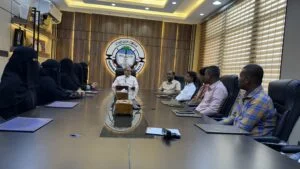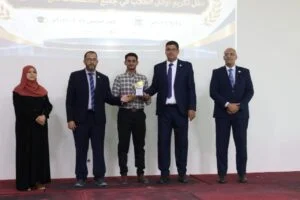
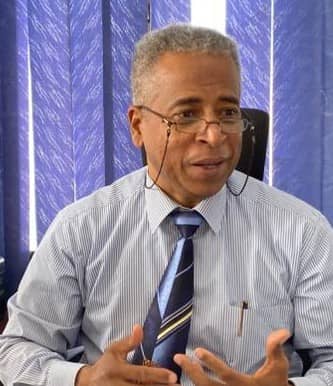
In an exclusive interview with Hadhramout University Gateway, Prof. Dr. Khaled Awad Al-Rubaki, Dean of the Faculty of Environmental Sciences and Marine Biology at Hadhramout University, highlighted the outcomes of the eleventh edition of the university’s Student Scientific Conference. He reviewed thirty-six research papers and graduation projects that proposed innovative solutions to pressing challenges in water resources, pollution control, and environmental sustainability.
Dr. Al-Rubaki affirmed that many of these scientific outputs are fully capable of evolving into industrial ventures, provided that adequate funding becomes available. He extended an open invitation to private sector institutions to adopt and support this promising talent.
“From the laboratory to the job market,” with this vision, the Dean reiterated that several student research projects are ready to transition into viable industrial investments. He explained that the primary obstacle lies not in scientific capability, but in the availability of sustained financial support. He called upon organizations and donors to invest in the intellectual potential of Yemeni youth, who are actively developing practical pathways to address environmental and water-related challenges.
Interview by: Abdulrahman Baharithah
Photography by: Ahmed Ba-Ruba’a
The Origins of the Student Scientific Conference
Responding to a question about the beginnings of the conference, Dr. Al-Rubaki stated: “In the name of Allah, the Most Merciful, the Most Compassionate. I thank you for this opportunity to address the readers of Hadhramout University Gateway. The idea of organizing the first Student Scientific Conference emerged in 2011, following a proposal by Prof. Dr. Mohamed Khanbash. The goal was to unlock students’ research potential and cultivate a strong academic culture.”
He explained that regional events in 2011 delayed implementation, but the university successfully launched the first edition in 2014.“The objective was clear,” he added. “We sought to ensure that student research achieved high quality and responded directly to societal needs. We wanted students to learn how to identify real problems, apply scientific methodologies, and generate practical solutions.”
The Eleventh Edition: A Platform for Excellence
Discussing the most recent conference, Dr. Al-Rubaki noted that Hadhramout University has organized student scientific conferences annually since 2014, completing eleven editions to date. The conference serves as an academic platform showcasing the best graduation projects from across the university’s faculties. Each faculty nominates its top two research projects, which are then evaluated according to established scientific criteria before being publicly presented. “For eleven years—except during the events of 2015—the conference has continued consistently,” he said. “This continuity reflects the university leadership’s strong commitment to highlighting student research that serves the community.”
Serving Society Through Research
Dr. Al-Rubaki emphasized that faculties prioritize research addressing tangible societal concerns, including water supply, electricity, infrastructure, marine resources, environmental degradation, pollution, and public health. This year’s edition featured thirty-six projects—fewer than in previous years, when participation reached up to sixty projects—yet, according to the Dean, the overall quality remained high. Participating faculties included Engineering and Petroleum, Medicine and Health Sciences, the Faculty of Women, Administrative Sciences, the Faculty of Environmental Sciences and Marine Biology, Arts and Humanities, Sciences, Nursing, and Computing and Information Technology.
From Research to Real-World Impact
When asked about the fate of these projects, Dr. Al-Rubaki acknowledged a persistent challenge: “We preserve these works as part of the university’s academic legacy. However, the real question is how to transform research papers into implementable solutions.” He explained that many decision-makers outside the university may not fully recognize the practical value of academic research. Bridging this gap requires improved communication, presentation skills, and stronger institutional partnerships. He highlighted the role of the Entrepreneurship Club in supporting promising student ideas and helping connect them with stakeholders. “The purpose of the conference, held on 9–10 February 2026, was not merely to display research, but to demonstrate that Yemeni students possess realistic and applicable solutions.”
Practical Examples: Biofuel and Sustainable Materials
Among the notable projects presented this year were research initiatives on biofuel production and environmentally friendly plastic alternatives. Dr. Al-Rubaki cited the example of a student who successfully extracted diesel from plastic waste, producing approximately two liters. Although the process required specialized equipment and significant cost, the experiment demonstrated clear feasibility. “These projects show strong potential,” he said. “But without sustained funding and institutional adoption, their impact remains limited.”
Partnerships and International Support
Addressing cooperation with external partners, Dr. Al-Rubaki confirmed ongoing coordination with civil society organizations, private sector entities, and development institutions. One prominent example is the fish farming project at the Faculty of Environmental Sciences and Marine Biology, supported by the Food and Agriculture Organization (FAO). He described the initiative as an important step in advancing applied research and contributing to local economic stability.