
Review by: Adeeb Al-Shatari
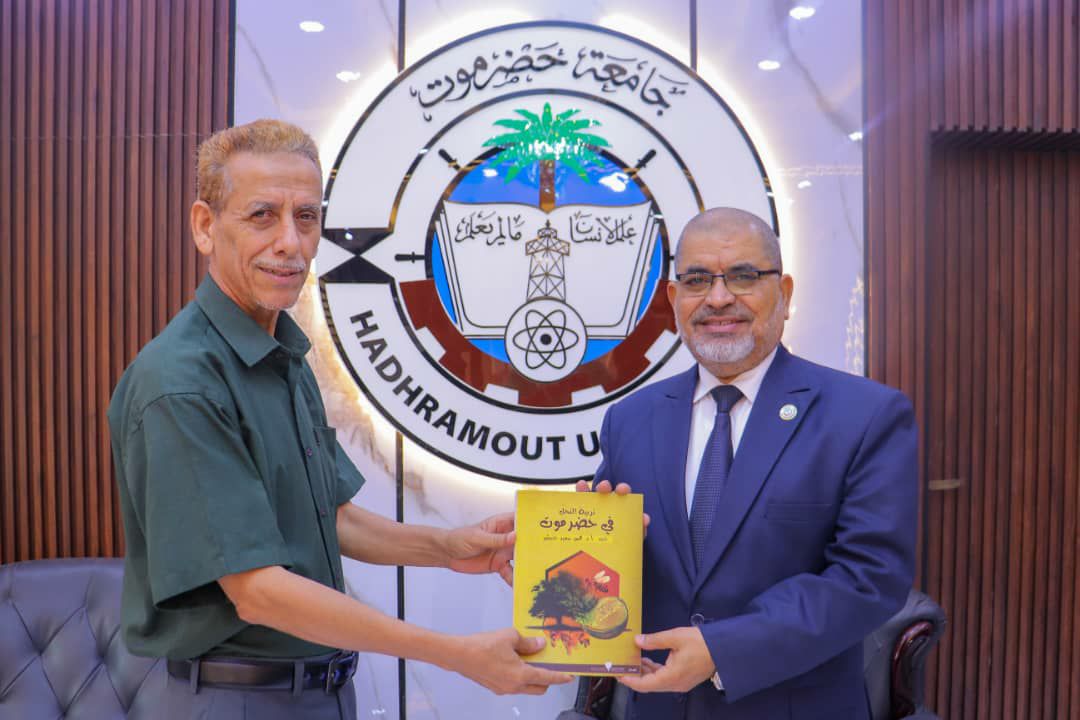
Yesterday, Prof. Dr. Mohamed Saeed Khanbash presented me with his book “Beekeeping in Hadhramout”. Upon browsing through its pages, I found it to be a comprehensive practical guide for every beekeeper, designed to support success in this field.
Spanning 167 pages in Arabic and 130 pages in English, the author crafts a work that embodies a profound dialogue between deep-rooted heritage and modern scientific evidence. It reflects his rich academic understanding and personal appreciation of the significance of this craft within Hadhramout’s society.
The Book and Its Essence
The reader enters the world of beekeeping in Hadhramout through its broad historical gateway. Khanbash establishes the subject by recalling the central role of this craft, which has been intertwined with the social and economic life of the governorate for centuries, earning a reputation that led early historians to list it among Yemen’s prominent commodities.
What captured my attention was the author’s candid acknowledgment of the continuity of traditional practices, which still form the backbone of Yemeni apiculture today. This admission does not merely document the past; it raises a fundamental question throughout the book: How can a deeply rooted craft be developed without compromising its authenticity?
From this question, Khanbash embarks on a comprehensive analytical journey, explaining in detail the complex organizational structure of bee colonies and their biological divisions. He offers practical comparisons between local and global bee strains—such as Ethiopian (with its three subspecies), Omani, Saudi, and others from regions like tropical North Africa—providing readers and beekeepers with tools for informed selection.
The scientific core of the book beats strongly when addressing the uniqueness of Hadhramout’s environment, highlighting the pivotal role of Sidr and Samar trees as essential pillars for the exceptional quality of honey. This discussion is supported by physical and chemical analyses that confirm the product’s distinctiveness and compliance with international standards.
The book’s practical contributions stand out through documented field comparisons between different beekeeping systems. Rather than limiting itself to theory, the author presents results from studies in Wadi Hadhramout, demonstrating the superiority of modern Langstroth hives in average honey production (12.5 kg per season) compared to traditional clay or wooden hives (9.6–9.7 kg).
This comparison does not aim to abolish tradition but to offer options that maximize economic returns for beekeepers, reflecting a balanced vision that combines identity preservation with technological advancement.
Enriched with vivid photographs that greatly enhance comprehension, the book goes beyond production to tackle daily challenges faced by practitioners. It provides practical solutions to issues such as combating the “Palm Wasp” pest in Wadi Hadhramout and suggests supplementary feeding strategies during forage scarcity, including yeast-gluten mixtures as pollen substitutes. These details reveal deep insight into field realities, making the guide a true companion for beekeepers in their daily work.
Ultimately, this book transcends its role as an academic reference to become a comprehensive developmental guide, linking the sustainability of beekeeping with broader issues such as poverty alleviation, biodiversity conservation through pollination, and community stability.
Through his extensive academic experience and field knowledge of Yemeni realities, Khanbash offers an inspiring model for leveraging this vital sector to strengthen the national economy and generate foreign currency.
 About the Author
Academic and Scientific Background:
Dr. Mohammed Saeed Mabrouk Khanbash earned his Ph.D. in Bee Science from the Academy of Sciences in Hungary in 1989. He began his academic career as a teaching assistant at the Faculty of Agriculture, University of Aden, in 1981, later becoming a full professor specializing in genetics. He also served as a visiting professor at the College of Food and Agricultural Sciences, King Saud University, between 2008 and 2009.
Administrative and Leadership Roles:
Dr. Khanbash has held several prominent leadership positions, including Vice Dean of the Faculty of Agriculture at the University of Aden and Director of its Agricultural Consulting Center. At Hadhramout University, he served as Director of the Honeybee Center, Director of the Palm and Dates Center, and Dean of the Faculty of Environmental and Marine Biology. Since 2012, he has been President of Hadhramout University.
Research and Publications:
Dr. Khanbash is recognized as one of the leading experts in bee research locally and regionally. His contributions include authoring more than nine specialized books, such as “Honeybees and Beekeeping in Yemen” and “Beekeeping and Honey Production in Yemen”, along with over 120 peer-reviewed scientific papers. He played a key role in developing the strategic plan for advancing beekeeping in Saudi Arabia and has participated in more than 80 scientific conferences and seminars.
Awards and Recognition:
He has received significant accolades for his scientific efforts, including the University of Aden Award for Research Promotion and the Hadhramout Governorate Award for Scientific Creativity.