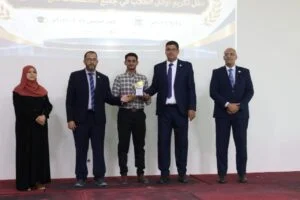
The researcher, Khaled Saleh Brik, who has a scholarship from HU to Mohammed V University, Faculty of Education, Rabat, Morocco, earned his Master degree after defending his thesis entitled (Aesthetic comparison between mud buildings in southern Morocco and Hadhramout), with a recommendation to publish.
The Examination Committee consisted of:
Prof. Dr. Abdullah Benatou /supervisor, Prof. Dr. Aabdal Karim El-Shabaki/ chair, and Prof. Ahmed Al-Khaldi and Prof. Dr. Malika Al-Mikawi.
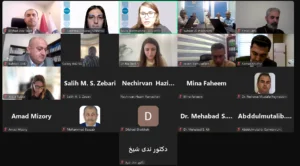
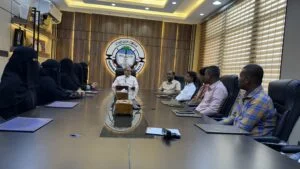
The defence session was held remotely through one of social media platforms due to Covid 19.
The thesis included a study on the comparison of the aesthetics of mud buildings as well as the techniques of mud buildings between Hadhramout and Morocco. It concluded the following:
There are similarities in building techniques of using flat bricks made of raw clay, with a large surface and low thickness, called (Mudar) in Hadrami, which are unlike those in Morocco have a small surface and a very large height, called (Al-Tabia). In additional, there is a method of building, called (Al-Dark), used for building large walls such as external walls and war castles. With regard to floors as well as roofs, they are made from large logs, crossed over and covered with palm fronds, and then mats of straw, woven locally.
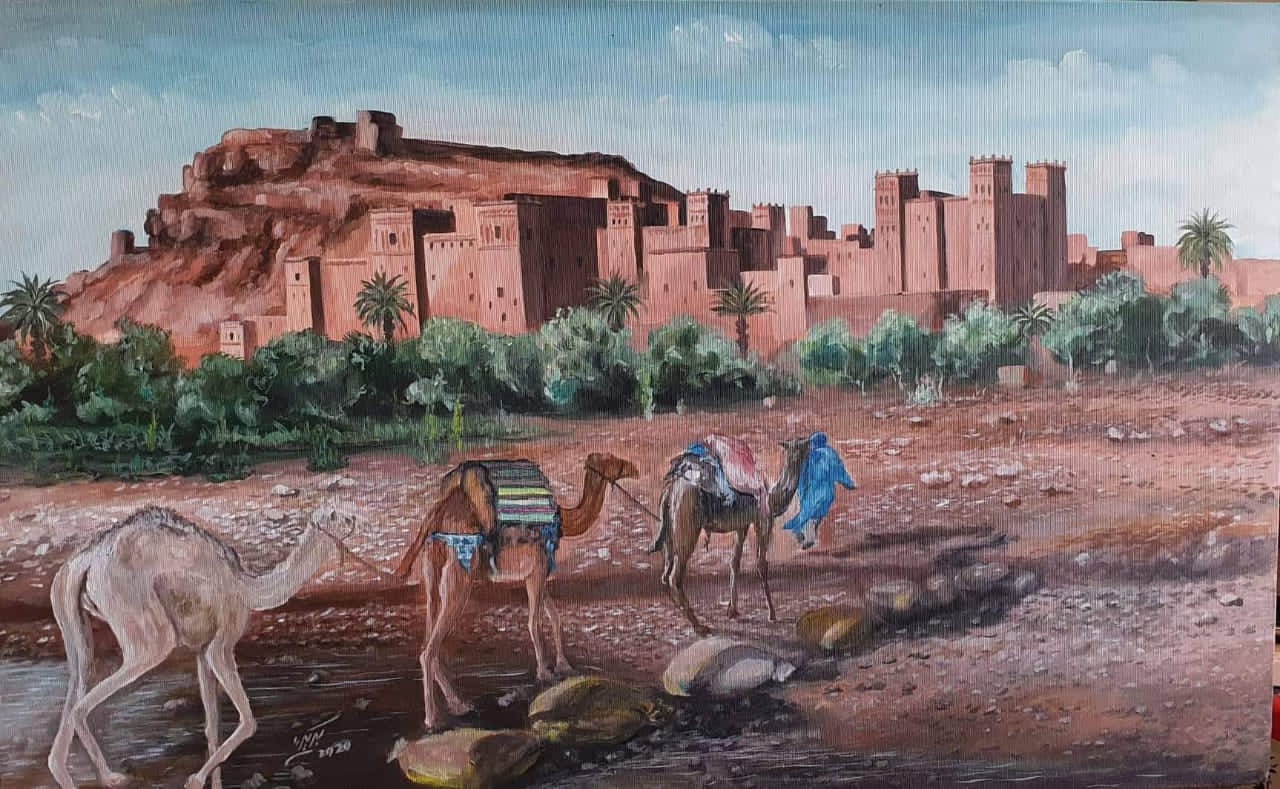
In the external form, the observer, at first glance, realizes the aesthetic similarities between the buildings of southern Morocco and the those of Hadhramout in the scope of our research which is limited to areas in Wadi Doan and Al-Hajreen in Yemen, and the city of Warzazat and Wadi Tadhghatah in Morocco.
We can say that the structure of both types has similarities in the external forms such as decoration, pottery, limestone decoration. And as for the internal planning, there is a difference in windows and balconies, which are (blind) in Morocco, and decorated perfectly. These windows overlook corridors inside the house.
There are also similarities in the environment, the degree of climate and the location on the hills or the mountains that overlook valleys, which are flowing in Morocco, and have torrents in Hadhramout, both the areas of study are also characterized by a vegetative cover, particularly palm trees.
In this research, forty paintings of both the countries were presented equally, in which the aesthetic and decorative values of the buildings were depicted from the outside. These paintings done by the student himself, in addition to analytical and self-critical reading . In the coming days, the researcher will also organize an exhibition about them.
This thesis also included about twenty-five illustrations and forty paintings.
For his part, Prof. Dr. Hadi Salim Al-Sabban, Acting Vice President of Hadhramout University of the Postgraduate Studies and Scientific Research, expressed his happiness with such technical studies that highlight the ancient status of Hadhramout as well as mud buildings as rich cultural heritage, they also highlight that students, having scholarships, can conduct solid researches, representing as a scientific window to take the cultural message of Hadhramaut to the world.