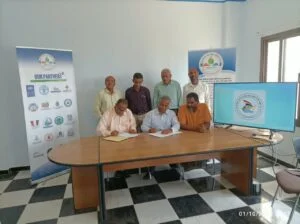
Hadhramout University, represented by the Faculty of Environmental Sciences and Marine Biology, has signed a joint cooperation agreement with the SFISH Project (Sustainable Fisheries Development in the Red Sea and the Gulf of Aden) of the United Nations Development Programme (UNDP), aimed at implementing a comprehensive scientific study to collect baseline data on the settlement of shrimp larvae and their natural habitats along the coastlines of Hadhramout and Al‑Mahrah Governorates.
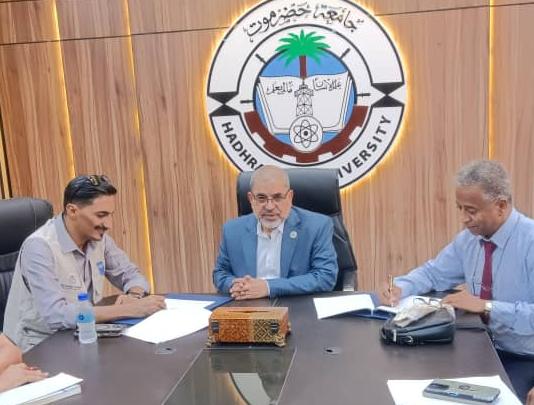
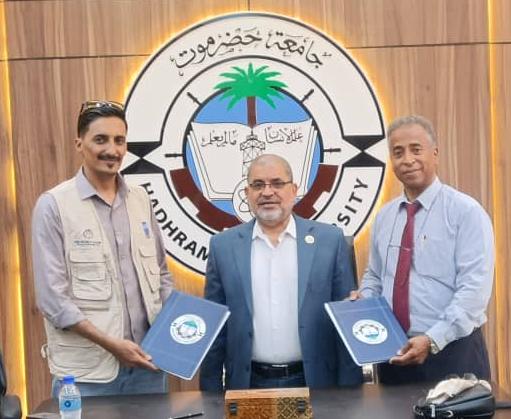
The procedural and documentation aspects of the agreement were finalized at Hadhramout University in the presence of the President of the University, Prof. Dr. Mohamed Saeed Khanbash, the Dean of the Faculty, Prof. Dr. Khaled Al‑Rubaki, and Mr. Jamal Al‑Houtali, the project representative in Hadhramout and Al‑Mahrah. This activity falls within the framework of the SFISH Project, which is funded by the World Bank (WB) with support from UNDP, as part of joint efforts to enhance scientific research and support sustainable development initiatives related to the fisheries sector and marine resources in Yemen.
The agreement aims to implement a detailed field survey to identify shrimp larvae breeding sites and classify them according to species and quality, in coordination with fisheries authorities and relevant stakeholders in the targeted areas. This approach seeks to strengthen scientific and institutional integration in support of marine resource sustainability. The study represents a fundamental step toward understanding fish stock dynamics and conserving marine biodiversity in the region.
Project supervisors emphasized that the results of this survey will contribute to supporting scientific research and establishing a reliable scientific database that can be utilized in the future to assess needs and develop potential interventions related to the fisheries sector and coastal development. Such outcomes are expected to benefit the region and contribute to strengthening food security in line with available capacities and development programs.
In this context, the President of Hadhramout University, Prof. Dr. Mohamed Saeed Khanbash, expressed his sincere appreciation to the SFISH Project team, UNDP, and the World Bank for their support of scientific and environmental studies and for selecting the coastlines of Hadhramout and Al‑Mahrah within the scope of this important study. He stated that this partnership reflects the confidence of international organizations in the academic and research capabilities of Hadhramout University’s staff and demonstrates the commitment of supporting entities to advancing sustainable development pathways and marine‑resource‑based scientific research. He also highlighted the qualitative progress the university has recently achieved through a number of developmental projects implemented in cooperation with humanitarian and development organizations, aimed at enhancing the infrastructure of education and research.
For his part, Mr. Jamal Al‑Houtali, Representative of the SFISH Project in Hadhramout and Al‑Mahrah Governorates, provided an overview of the project’s activities in Yemen, which are expected to continue until early 2027. He explained that the project focuses on strengthening the sustainability of the fisheries sector and supporting efforts to develop it.
Mr. Al‑Houtali noted that over recent years, the project has implemented several qualitative interventions aimed at supporting and developing the fisheries sector, stressing the importance of scientific and research initiatives in providing accurate data and indicators that can assist relevant authorities and decision‑makers in formulating policies and plans for the protection and sustainable development of fisheries resources in Yemen.
He also emphasized the high level of coordination and cooperation between Hadhramout University, fisheries authorities, and relevant institutions in Hadhramout and Al‑Mahrah, praising the facilitation and continuous coordination provided by these entities in support of project activities and fisheries‑related interventions, which contribute to creating an enabling environment for the successful implementation of the study and the achievement of its scientific and developmental objectives.
The completion and documentation ceremony was attended by Dr. Adeeb Al‑Shatiri, Director of the University Media Directorate, and Mr. Mohammed Bashadi, Secretary‑General of the Faculty.