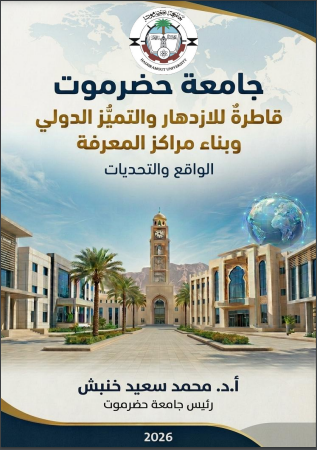
A new bilingual book (Arabic and English) has recently been published by the President of Hadhramout University, Prof. Dr. Mohammed Saeed Khanbash, entitled:
“Hadhramout University: A Catalyst for Prosperity, International Excellence, and Knowledge Hub Development – Reality and Challenges.”
This publication comes at a critical moment as the university seeks to redefine its role, moving beyond traditional academic models toward a more development‑oriented and innovation‑driven approach.
The book, comprising 126 pages, opens with a presentation of the university’s vision, mission, and institutional values, grounded in the practical experience of Hadhramout University, which the author describes as a “driving force,” highlighting its leadership role in advancing sustainable development in Hadhramout.
In the first section, the author examines the relationship between the university and the drivers of economic prosperity, noting that since its establishment, the university has supplied the labor market with approximately 48,323 graduates holding bachelor’s, master’s, and doctoral degrees, as part of its efforts to bridge the gap between higher education outcomes and the demands of local and regional labor markets.
The second section addresses international excellence and internationalization, presenting practical mechanisms for building global partnerships. These include enhancing the capacities of faculty members and their assistants in line with rapid scientific advancements and the evolving needs of both local and international labor markets.
In the third section, the author outlines a vision for transforming the university into a regional hub for knowledge production—not merely through knowledge importation, but by localizing scientific research and linking it to regional priorities such as environmental issues, energy, and water resources. This is to be achieved through the establishment of specialized research centers, including the Center for Environmental Studies and Water Resources, the Beekeeping Center, and the Women’s Training and Research Center.
The fourth section explores the challenges and opportunities facing the university, addressing financial constraints, limited research infrastructure, and the broader economic and developmental context, as well as the gap between current realities and aspirations, presented through a balanced and analytical perspective.
The book concludes with a fifth section offering a forward‑looking, actionable vision based on quality, innovation, and sustainability, aimed at strengthening the university’s role in community service and the advancement of scientific research.