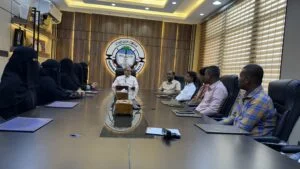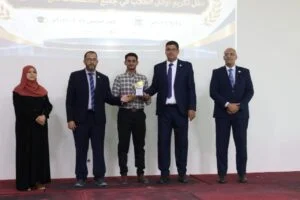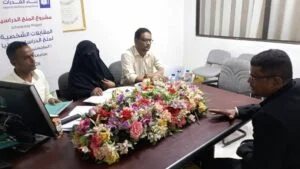
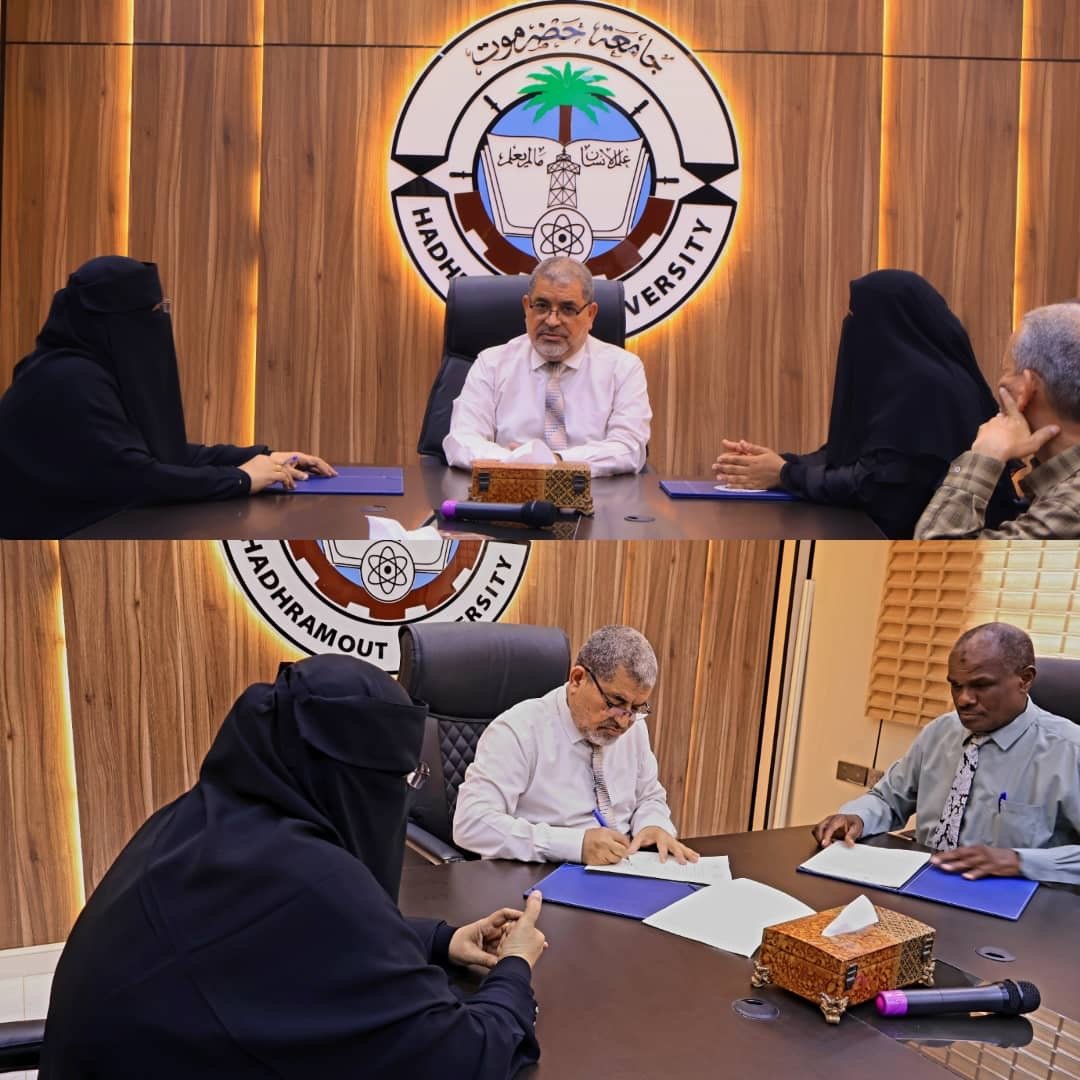
Prof. Mohamed Khanbash, President of Hadhramout University, witnessed today the signing of two academic cooperation agreements with the Hadhramout Foundation for Humanitarian and Strategic Studies and the Al-Amal Cultural, Social, and Women’s Foundation (Biozone Center for Research, Studies, and Environmental Protection), as part of the University’s commitment to strengthening academic and research partnerships with scientific institutions at the local and regional levels.
The first agreement was signed by Prof. Rizq Al-Jabri, Executive Director of the Hadhramout Foundation for Humanitarian and Strategic Studies, representing the first party, and Prof. Fathia Mohammed Bahashwan, Director of Hadhramout University’s Center for Humanities and Social Sciences, representing the second party.
The memorandum, endorsed by the University President in the presence of representatives of both parties, aims to establish a framework for scientific and research cooperation in several areas, including the implementation of joint research projects and studies, the exchange of publications and academic journals, the organization of scientific events such as seminars, conferences, and workshops, and the exchange of academic and professional expertise in the fields of humanities and social sciences. The agreement also aims to foster training and professional development opportunities for researchers and affiliates of both institutions, as well as promote collaboration on scientific projects that address local and regional community issues.
The memorandum further provides for the formation of a joint coordination team to oversee implementation and develop periodic action plans, with the details of each activity to be determined separately according to the capacities and resources of both parties.
The agreement will remain in effect for three years, renewable upon mutual consent, while ensuring that each party retains its intellectual and academic property rights as specified in individual joint projects.
In a related development, a second agreement was signed between the Center for Humanities and Social Sciences at Hadhramout University and the Al-Amal Cultural, Social, and Women’s Foundation (Biozone Center for Research, Studies, and Environmental Protection).
The agreement was signed on behalf of the Center by Prof. Fathia Mohammed Bahashwan, Director of the Center for Humanities and Social Sciences, while Dr. Abha Abdullah Baawaidhan, Director of the Foundation, represented the second party.
This memorandum aims to foster cooperation in areas of mutual interest in accordance with applicable laws and regulations. Areas of collaboration include coordinating and documenting joint activities related to research, studies, and capacity building; conducting field surveys and evaluation studies; organizing conferences, seminars, workshops, and specialized training programs; exchanging books, journals, and research findings; facilitating access to libraries and available facilities; and providing scientific, research, and training consultancy services.
The agreement also stipulates the holding of periodic meetings between the two parties to evaluate implemented programs and discuss matters of mutual interest. The agreement will remain valid for three years from the date of signing and will be automatically renewed unless either party provides written notice of its intention not to renew at least two months before its expiration.
These agreements form part of Hadhramout University’s strategy to strengthen its role as a leading academic and research institution and to open new avenues for cooperation with scientific and research organizations, thereby contributing to the advancement of scientific research and supporting development issues in Hadhramout and Yemen as a whole.
The Center for Humanities and Social Sciences at Hadhramout University is a specialized research unit dedicated to conducting studies, research projects, seminars, and workshops related to humanitarian and social issues. Meanwhile, the Al-Amal Cultural, Social and Women’s Foundation, through its Biozone Center, is recognized for its work in research, studies, and environmental protection, making this partnership a valuable addition to the region’s research landscape.